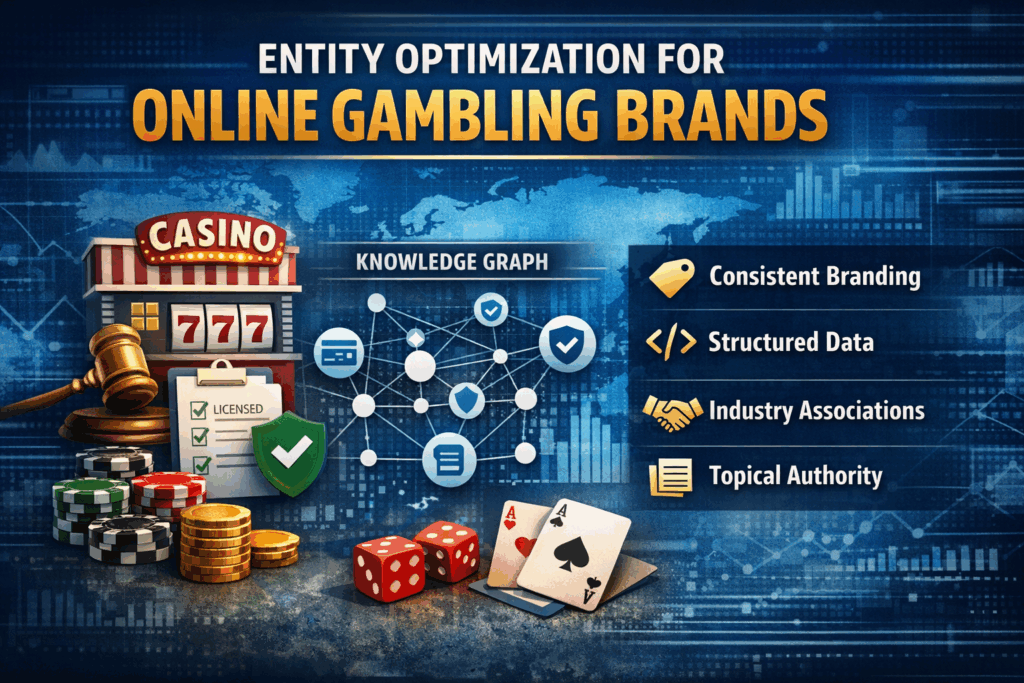
Online gambling SEO has evolved beyond keywords and casino backlinks. Search engines now evaluate how brands exist within a broader web of relationships, topics and trust signals.
In this environment, visibility depends not only on what a page says, but on how clearly a brand is defined across the digital ecosystem.
For online gambling brands, that definition must be precise. Regulators, payment providers, software developers and jurisdictions all form part of the industry structure. Search engines map these connections. When a brand is clearly associated with relevant entities, its authority strengthens.
This piece explains how entity optimization works in the iGaming sector and why it has become essential for long-term search performance.
What Is an Entity in SEO?
An entity is a clearly defined thing that search engines can recognize and understand without confusion.
In the iGaming sector, entities include online casino brands, sportsbook operators, gaming regulators, licensing authorities, software providers, payment processors and even specific jurisdictions. Each of these exists as a distinct concept in search engines’ knowledge systems.
Search engines do not evaluate pages in isolation. They map relationships between entities. They identify how a casino brand connects to a regulator, how a payment method connects to gambling transactions and how a software provider connects to multiple operators.
For example, if an online casino is consistently associated with a known licensing authority and recognized payment providers, those connections strengthen its classification within the gambling ecosystem. If those associations are unclear or inconsistent, the brand becomes harder to categorize.
Entity optimization ensures that search engines can identify your brand, understand what it does and place it accurately within the wider iGaming structure.
Why Entity Optimization Matters in iGaming
iGaming operates in a high-scrutiny environment. It intersects with finance, regulation and consumer protection. That raises the threshold for trust.
Search engines must determine whether a gambling brand is legitimate, compliant and clearly defined. Entity signals help answer those questions. When a brand is consistently associated with recognized regulators, payment providers and software developers, classification becomes easier and trust increases.
In competitive niches, ambiguity weakens authority. If a brand appears across unrelated topics, inconsistent descriptions or low-context mentions, search engines receive mixed signals. Mixed signals reduce confidence.
Entity optimization reduces that ambiguity. It aligns brand mentions, contextual associations and structural data into a coherent profile. That coherence supports rankings in a sector where competition is aggressive and evaluation standards are higher than average.
For online gambling brands, entity clarity is not cosmetic. It is foundational.
Core Components of Entity Optimization for Gambling Brands
Entity optimization requires consistency across multiple layers. It is not one tactic. It is a framework that aligns structure, content and external signals.
Below are the core components that define strong entity positioning in the iGaming sector.
Consistent Brand Signals
Your brand name should appear in a consistent format across your website and external mentions. Variations in naming, inconsistent abbreviations or shifting descriptors create ambiguity.
If your official name includes specific terms such as “Casino” or “Gaming,” use them consistently. Maintain the same branding in title tags, headers, structured data and external profiles.
Clarity strengthens recognition.
Structured Data Markup
Structured data helps search engines understand your organization as a defined entity.
Using schema markup for organization details allows search engines to identify:
- Official name.
- Website URL.
- Logo.
- Founding details.
- Social profiles.
Structured data does not create authority on its own. It reinforces identity. In regulated sectors like iGaming, that reinforcement improves classification accuracy.
Contextual Mentions in Relevant Environments
Links are valuable, but contextual mentions also matter.
When authoritative gambling or fintech publications reference your brand within relevant discussions, those mentions strengthen entity associations. The context surrounding the brand name tells search engines what your organization represents.
For example, a brand cited in an article discussing gambling compliance sends a stronger signal than a random mention in unrelated content.
Relevance defines the strength of the association.
Association With Recognized Industry Entities
Strong entities connect to other recognized entities.
In iGaming, this may include:
- Licensing authorities.
- Payment processors.
- Software providers.
- Regulatory bodies.
When your brand is consistently mentioned alongside established industry players, search engines gain confidence in its position within the ecosystem.
These relationships create a network of trust.
Topical Depth and Focus
Entity strength begins internally.
Your website should demonstrate expertise in its core topic. That means structured content around regulation, payments, security, responsible gambling and market analysis.
A site that covers scattered topics with little depth sends weak signals. A focused site with layered content reinforces its identity as a defined gambling entity.
Common Entity Optimization Mistakes in iGaming
Many gambling brands invest heavily in backlinks while overlooking structural clarity. That imbalance creates visibility gaps.
Below are common mistakes that weaken entity signals.
Inconsistent Brand Naming
A brand that appears under different names across platforms creates confusion.
For example, if a casino is referred to as “ABC Casino” on its website, “ABC Gaming” in guest posts and “ABC Online” in directory listings, search engines must determine whether those references point to the same entity. Inconsistency reduces clarity.
Standardization matters.
Thin Topical Coverage
Some gambling sites focus only on commercial landing pages. They lack supporting iGaming content around regulation, compliance, payments or industry analysis.
Without topical depth, the entity appears narrow and transactional. Search engines struggle to associate it with broader gambling concepts.
Depth reinforces identity.
Over-Optimized Anchors and Forced Mentions
Entity signals should appear natural.
If every mention of a brand includes aggressive commercial anchors, the pattern looks engineered. Search engines evaluate language patterns. Repetition that lacks editorial flow weakens credibility.
Natural contextual mentions are stronger than forced keyword placements.
Ignoring Structured Data
Structured data helps define an organization clearly. When it is missing or poorly implemented, search engines rely entirely on contextual inference.
In a complex and regulated sector, explicit clarity is preferable to assumption.
Associating With Low-Quality Networks
If a gambling brand appears primarily on low-authority link networks or thin affiliate pages, it becomes associated with those environments.
Search engines evaluate relationships. Weak associations dilute authority.
Entity Optimization and Long-Term Authority
Entity optimization is not a short-term ranking tactic. It is a structural investment.
When a gambling brand maintains consistent naming, clear associations and focused topical coverage, search engines can classify it with confidence. That classification supports stable rankings across related queries.
Over time, consistent entity signals compound. Each relevant mention strengthens the brand’s position within the iGaming ecosystem. Each structured data implementation reinforces identity. Every contextual association builds trust.
In competitive sectors, stability matters as much as growth. Sites that rely only on aggressive link acquisition often see volatility. Sites that build clear entity profiles tend to hold positions longer because their authority rests on structure, not surface metrics.
Entity optimization also supports expansion. When a brand has strong entity clarity, it becomes easier to rank for new subtopics within its niche. Search engines already understand what the brand represents.
For online gambling brands, entity optimization forms part of a durable SEO framework. It strengthens classification, reinforces trust and supports sustainable visibility in a regulated and competitive market.
Conclusion: Clarity Creates Authority
In iGaming SEO, authority is not built through volume alone. It is built through clarity.
Search engines evaluate how well a brand is defined, how consistently it appears across the web and how clearly it connects to relevant industry entities. Backlinks matter. Content matters. But without structural identity, those signals lack cohesion.
Entity optimization aligns brand naming, contextual mentions, structured data and topical depth into a unified profile. When those elements reinforce each other, classification strengthens and trust increases.
For online gambling brands operating in competitive and regulated markets, clarity is a competitive advantage. The more precisely search engines understand who you are and how you fit within the iGaming ecosystem, the more stable and defensible your rankings become.