iGaming is one of the most competitive sectors in online marketing, where casino operators compete for rankings, affiliates compete for traffic, and regulators monitor the space with increasing scrutiny. In this environment, backlinks continue to play a major role in search visibility.
But not all backlinks are equal.
Many links look strong on paper, often supported by high domain ratings or large content archives, yet they fail to move rankings in a meaningful way. In iGaming, surface metrics rarely tell the full story.
An iGaming authority backlink has structure behind it. It sits in the right context, comes from a relevant source, and signals trust rather than manipulation.
This article breaks down the core elements that separate a true authority backlink from a wasted budget.
What Is an iGaming Authority Backlink?
An iGaming authority backlink is not defined by a single metric. It is defined by alignment.
It comes from a website that is trusted in the gambling, finance, regulatory or adjacent technology space. The linking page discusses a topic that is directly related to online casinos, sports betting, payments, compliance or digital gaming. The link appears naturally within that discussion.
Authority in this context means credibility and relevance working together.
For example, a link from a detailed analysis of U.S. online gambling regulation carries more weight than a link from a general lifestyle blog, even if both sites show similar third-party metrics. Search engines evaluate signals in context. They look at subject matter, language, surrounding entities and overall topical focus.
An authority backlink also looks editorial. It reads like a citation or reference, not an advertisement. It supports the content rather than interrupting it. The placement feels earned.
In short, an iGaming authority backlink is a contextual endorsement from a relevant and trusted source. It strengthens your site because it fits naturally within the structure of the web.
The Core Components of an iGaming Authority Backlink
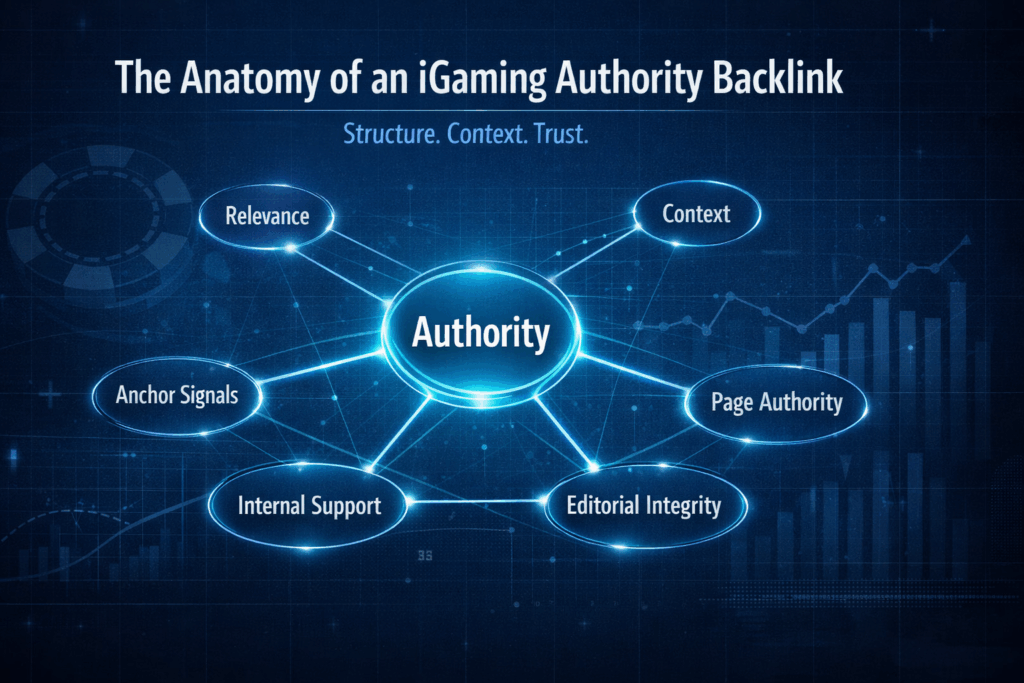
An authority backlink is not one single feature. It is a combination of signals that work together. When those signals align, the link becomes an asset. When they do not, it becomes noise.
Below are the core components that define a strong iGaming authority backlink.
Topical Relevance
Relevance is the foundation.
The linking site should operate in or near the iGaming space. That includes online casinos, sports betting, gambling law, fintech, payments, blockchain gaming or regulatory policy. The closer the topical alignment, the stronger the signal.
A link from a gambling compliance article carries more weight than a link from a generic business blog. Even if both sites show similar metrics, the relevant one reinforces subject authority.
Search engines evaluate topics, not just links. If the surrounding content discusses casino regulation, player protection or payment systems, the backlink supports your site’s position within that ecosystem.
Contextual Placement
Where the link sits matters.
An authority backlink appears inside the main body of the content. It is placed within a paragraph that discusses the related topic. It is surrounded by relevant language.
A link embedded in a sentence about U.S. casino legislation sends a stronger signal than a link placed in a sidebar, footer or author bio. Context gives the link meaning.
The placement should feel editorial. It should read like a reference, not a promotion.
Page-Level Authority
Many buyers focus on domain metrics. That is a mistake.
Search engines evaluate pages, not just domains. A strong backlink comes from a page that is indexed, crawled regularly and supported by internal links. The page should have its own authority and purpose.
A link from a well-linked regulatory guide carries more weight than a link from a thin page that exists only to host outbound links.
If the page receives traffic or ranks for relevant terms, that is an additional positive signal.
Anchor Text and Language Signals
Anchor text should match the context.
Natural anchors use brand names, neutral descriptions or partial phrases that fit smoothly within the sentence. Over-optimized anchors often look forced and can weaken the signal.
For example, a sentence that references “an analysis of online casino payment trends” feels natural. A sentence stuffed with commercial keywords does not.
Language around the link also matters. The surrounding words help search engines understand why the link exists.
Editorial Integrity
Authority requires credibility.
The linking site should publish consistent content. It should have a clear audience. It should not display obvious link selling patterns or excessive outbound placements.
If a page links to dozens of unrelated gambling sites in one article, the signal weakens. If it references a small number of sources in a structured, informative piece, the signal strengthens.
Editorial integrity protects the long-term value of the backlink.
What Is Not an Authority Backlink?
Understanding what qualifies as authority is only half the equation. It is just as important to understand what does not.
In iGaming, many backlinks appear impressive at first glance. They show strong third-party metrics. They sit on domains with thousands of pages. They may even look polished. Yet they fail to produce measurable movement in rankings.
Here are common examples of links that often fall short.
High Metrics, Low Relevance
A link from a high-domain blog in an unrelated niche rarely carries meaningful weight in iGaming.
For example, a generic lifestyle site with strong metrics may link to an online casino guide. On paper, the numbers look strong. In practice, the topical gap weakens the signal. Search engines evaluate context. If the site has no established relationship to gambling, finance or digital gaming, the endorsement carries less authority.
Guest Post Farms
Some sites exist primarily to publish sponsored content. They accept posts across dozens of unrelated industries. Each article contains multiple outbound links to commercial sites.
These pages often look clean and well-written. However, the pattern is visible. When a site publishes content about casinos one day, CBD products the next and crypto exchanges the day after, the editorial signal weakens.
Consistency matters.
Link Lists and Directory Pages
A page that lists 50 casino brands with little commentary rarely acts as a strong authority signal. These pages often exist to host outbound links rather than provide analysis.
Search engines can detect thin content and template structures. If the page does not offer depth, its endorsement carries limited weight.
Sitewide Footer Links
Sitewide links placed in footers or blogrolls may generate volume, but they rarely generate authority. Because they appear on every page, they lack contextual depth.
An editorial link placed within a relevant article almost always carries more value than hundreds of repeated links in a footer.
Orphaned Pages
If the linking page receives no internal links and sits outside the main site structure, its impact is reduced. A page that no other page references sends a weaker signal than one integrated into a broader content ecosystem.
Authority is structural. It depends on context, relevance and integration. When those elements are missing, the backlink may inflate metrics but fail to influence rankings in a meaningful way.
How to Evaluate an iGaming Backlink Before You Invest
In iGaming, link budgets are often significant. That makes evaluation critical. A single strong backlink can support rankings for months. A weak one can drain budget without impact.
Before investing in any placement, use a structured review process.
Check Topical Alignment
Start with the obvious question: does the site operate in or near the iGaming space?
Look at recent articles. Are they about online casinos, betting markets, gambling regulation, fintech or digital payments? Or are they about unrelated topics with occasional casino posts mixed in?
If gambling appears as a side topic rather than a core theme, the authority signal may be limited.
Review the Linking Page Itself
Open the exact page where the link will appear.
Is the article detailed and informative? Does it offer analysis or original commentary? Is the link placed naturally within a relevant paragraph?
If the page feels thin or exists mainly to host outbound links, reconsider.
Examine Internal Support
Check whether the linking page receives internal links from other parts of the site. A well-supported page sits inside a clear content structure. It is not isolated.
You can often see this by browsing related articles or checking whether the page appears in navigation menus, topic hubs or category archives.
A page that is integrated into the site architecture usually carries stronger authority.
Assess Outbound Link Patterns
Look at how many external links appear on the page and across the site.
If every article links to multiple commercial gambling brands, the signal may look transactional. If outbound links are selective and relevant, the endorsement appears more editorial.
Patterns matter more than single instances.
Confirm Indexing and Visibility
Search for the page in Google. Make sure it is indexed. Look at whether the site ranks for gambling-related terms.
If the site has no visibility in relevant queries, its authority may be limited, regardless of third-party metrics.
Why iGaming Backlinks Require Higher Standards
Not all industries face the same level of scrutiny. iGaming operates under tighter conditions than most sectors.
Online gambling sits at the intersection of finance, regulation and consumer protection. Payment processors monitor transactions. Regulators enforce licensing rules. Search engines apply additional sensitivity to gambling-related queries. That combination raises the bar for trust signals.
Because the niche attracts aggressive SEO tactics, it also attracts algorithmic filtering. Low-quality link schemes are common. Over-optimized anchors are common. Private networks are common. As a result, search engines evaluate gambling backlinks with greater skepticism.
This means average links rarely produce average results. In less competitive industries, a moderate link profile may still move rankings. In iGaming, links must demonstrate clear relevance, editorial integrity and structural strength.
There is also a reputational layer. Gambling brands operate in markets where compliance matters. Associations with low-quality domains can create risk beyond rankings. A backlink is not just an SEO signal. It is a public association.
For these reasons, iGaming authority backlinks require higher standards. Precision matters more than volume. Quality compounds over time. Weak signals accumulate risk.
In a competitive and regulated environment, authority is built deliberately. Each link should strengthen the overall structure, not just inflate a metric.